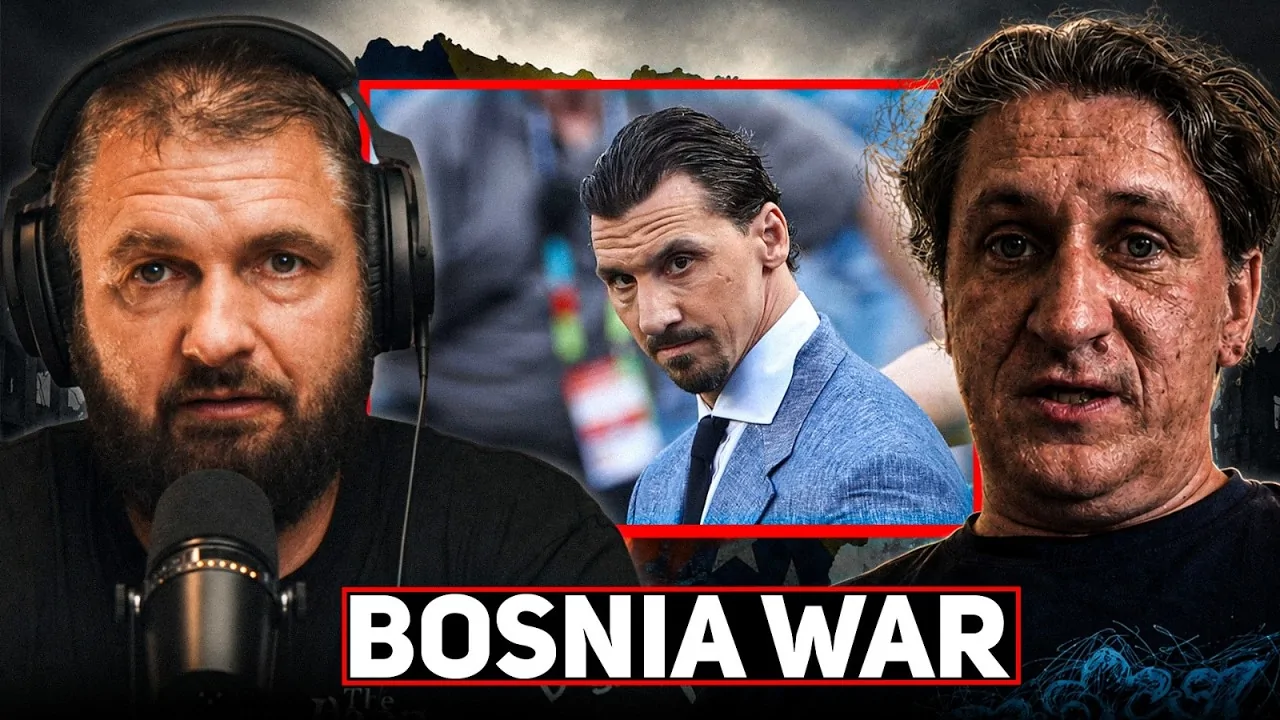
When 70,000 voices rose in chorus across a packed stadium in the United States, singing a Bosnian love song about lilies, even Zlatan Ibrahimović — one of the most composed and commanding athletes of his generation — could not hold back his tears. “My father’s roots,” he said, visibly overcome, “just to see 70,000 singing… Bosnian fans already won the World Cup.” For anyone who understands what Bosnia endured in the 1990s, that moment carried a weight far beyond sport. It was a declaration of existence from a people who were meant to be eliminated — a living testament to the resilience that faith in Allah ﷻ instils in those who persevere. In this powerful episode of TheDeenShow, host Eddie sits with Harun Mhmedović, a Bosnian filmmaker, cinematographer, and survivor of the four-year siege of Sarajevo — the longest siege of a capital city in modern history — whose documentary work has dedicated itself to preserving the memory of a genocide the world is still trying to erase.
Football as Resistance: The Deeper Story Behind Zlatan’s Tears
- The song that moved Ibrahimović was a 1991 love song whose imagery of lilies became the symbol of multi-ethnic Bosnia — the flag the Bosnjaks carried into those World Cup stadiums bore lilies referencing the original 1992 Bosnian independence flag and the historic Bosnian kingdom.
- The Bosnian fans packed US stadiums because the United States holds the largest Bosnian diaspora outside Bosnia itself — many of whom also organised pro-Palestine marches before matches, an act of solidarity rooted in shared Muslim experience.
- Edin Džeko, one of Bosnia’s greatest ever footballers with over 400 career goals, survived the siege of Sarajevo as a young boy — playing football on concrete streets because the city’s football pitches had been converted into graveyards to cope with the sheer number of deaths under bombardment.
- Harun Mhmedović himself was under siege in Sarajevo alongside Džeko, using football as a form of psychological and spiritual resistance — going outside to play even under sniper fire as a statement that the human spirit cannot be crushed.
- Ibrahimović, though born in Sweden, carries deep Bosnian roots through his father — and his legendary confidence throughout his career was, according to Harun, drawn in part from the survivor’s mentality of people who were meant not to be alive.
“How much this country has suffered — and to see this happiness. It makes me very emotional, gives me goosebumps because that’s my father’s roots. Probably the Bosnian fans already won the World Cup.” — Zlatan Ibrahimović
The global attention that Zlatan’s emotional reaction drew was not accidental — it opened a window for millions of football fans to ask: why does a World Cup mean this much to Bosnians? The answer is that Bosnia was a country its aggressors designed not to exist. Between 1992 and 1995, Serb extremists pursued the creation of an ethnically pure ethnostate through the systematic siege, massacre, and expulsion of Bosnjaks — who are predominantly Muslim and indigenous to the land, having embraced Islam during the Ottoman period. Children like Džeko and Harun ran through streets where shells could fall at any moment, and the football pitches where their peers once played had become the resting places of the dead. For these communities, Islam was not incidental — it was the spiritual core that gave meaning to survival, the source of sabr and tawakkul that sustained a people through the darkest chapter in modern European history.
Warning Signs of a New Storm: The Frozen Conflict the World Refuses to See
- The Dayton Agreement of 1995 did not resolve the Bosnian conflict — it merely froze it, rewarding the perpetrators of genocide with 49% of Bosnian territory and creating the entity of Republika Srpska within Bosnia’s borders.
- 99% of war criminals from the 1992–1995 genocide remain unpunished and free — an impunity that emboldens the continuation of the same ethnostate ideology to this day.
- A reported $1.6 billion arms deal supplying Serbia, including advanced drone technology, has alarmed regional analysts — raising urgent questions about who these weapons are intended to be used against in a region where Bosnia and Kosovo remain the most vulnerable targets.
- Weapons factories are being established within Republika Srpska — directly mirroring the covert arming of Serb civilian populations that took place in 1990–1991 in the lead-up to the last genocide.
- Political rhetoric from key regional leaders now mirrors the language heard in 1989–1991 — language the ten-stage genocide model places at Stages 4–5: dehumanisation and organisation, while the previous genocide sits at Stage 10: denial and erasure of evidence.
- Croatian extremist voices have grown louder, pushing for Bosnia to be partitioned between Serbia and Croatia — which would leave Bosnjaks facing aggression on two fronts simultaneously, a scenario Harun describes as potentially the first “two-sided genocide” in modern history.
Among the countless testimonies Harun has documented in his years of filmmaking, two stand out for their power to illustrate how deeply ideology can corrupt the human soul. The first is the story of Stipa Variota — a 15-year-old boy with cognitive disabilities living in a care home in Sarajevo at the start of the siege. When the facility released children whose parents lived in Serb-controlled areas, Stipa returned to his mother in Kalinovik. When extremist forces came to organise the local Serb population, they questioned his mother’s loyalty because Stipa had been born to a non-Serb father. Her response — to hand over her own disabled child as proof of her allegiance to the ethnostate cause — was, as Harun solemnly notes, not the act of a psychopath, but of someone so completely brainwashed by a dehumanising ideology that maternal instinct was extinguished. The second comes from Sanski Most, where a sole survivor led investigators to a mass grave of 124 men. When forensic teams excavated the site, they discovered beneath those 1992 victims the bones of people killed in 1944 — multiple layers of the same ideology, targeting the same community, buried in the same earth across generations. These are not ancient wounds. They are still open.
“We are in Stage 10 of denial of the last genocide — and probably Stage 4 or 5 of the next. People have to understand: this was never resolved. It was just frozen.” — Harun Mhmedović
In Islam, the duty to bear witness — to speak truth about injustice even when it is deeply uncomfortable — is not a matter of choice. The Quran commands the believers to stand firmly for justice as witnesses for Allah ﷻ, even if it is against themselves or those close to them (4:135). Bosnia is not a closed chapter; it is an open wound whose perpetrators walk free, whose ideology remains active, and whose predominantly Muslim people still live under the shadow of a conflict the world declared over but never truly ended. The evidence Harun Mhmedović has spent years collecting, and the stories he carries both as a survivor and as a filmmaker, demand that the global Muslim ummah and all people of conscience refuse the comfort of forgetting. Learn the history of Bosnia. Understand the warning signs. Amplify the voices of its survivors. And recognise that standing for the oppressed — wherever they are, whatever the political cost — is among the highest and most enduring expressions of the deen. May Allah ﷻ protect the Muslims of Bosnia, grant His mercy to the martyrs, bring justice to those still waiting, and grant us all the clarity of heart to see the truth before history repeats itself.